
What You Can Do to Support Nuclear Disarmament
A Conversation with Seth Shelden on Treaty: A Play About How to Not Blow Up the Planet
A Conversation with Seth Shelden on TREATY
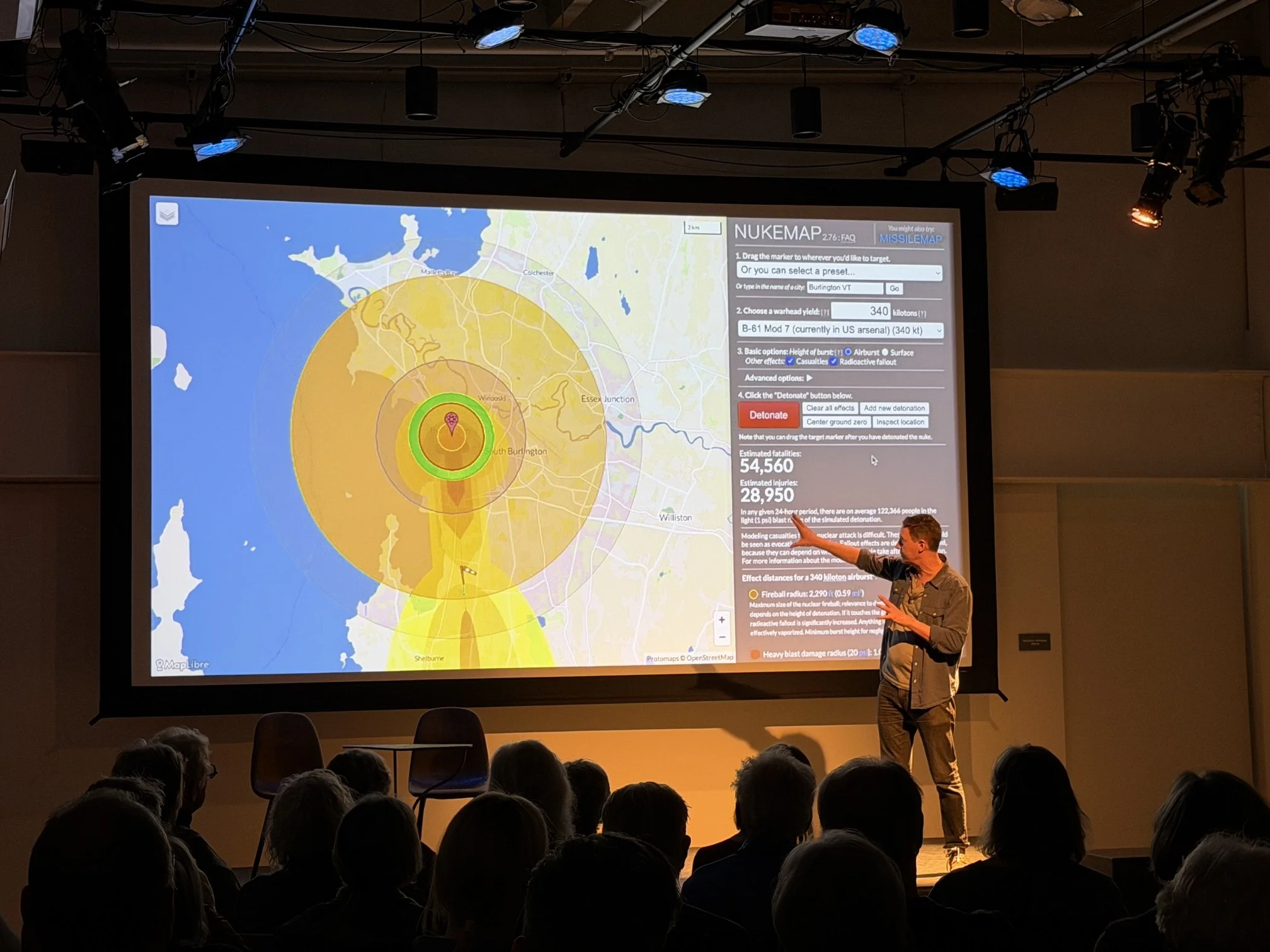
Seth Shelden demonstrates the impact of a simulated 340-kiloton nuclear detonation over Burlington, VT using NUKEMAP during a performance of Treaty at Town Hall Theater. Photo: Kate Middleton
In March 2026, Town Hall Theater hosted Treaty: A Play About How to Not Blow Up the Planet, by Chris Thorpe, presented by Ground UP Productions. After the run, we followed up with Seth Shelden, who played the role of Chris in the show, to continue the conversation that began during the post-show talk-backs. Aside from being an actor, Seth is General Counsel at the International Campaign to Abolish Nuclear Weapons (ICAN), Nobel Peace Laureate 2017. We're grateful to Seth, director Kate Middleton, and the entire Ground UP team for bringing this work to our community.
Given that world leaders seem to be ignoring so many rules, does international law even matter?
It’s understandable if people are feeling despondent, and dismissive, particularly given current events, about the utility of international law. But consider what the world would look like if these legal structures under attack today hadn't existed in the first place. Many aspects of your daily life, from purchasing groceries to traveling on an airplane, are only possible because the vast majority of international law is followed the vast majority of the time.
It may help to think about treaties as instruments that shape norms as much as impose penalties – which is often true with domestic law as well. Do you refrain from stealing sandwiches from Hannaford only because it's illegal? Or does the law also shape your sense that theft is something you don't want to do, even when you could get away with it? There’s no question that laws can be transgressed, but legal structures serve just as much as normative fortresses of sorts, and the point is that transgressing them would be still easier if we hadn’t built them to begin with.
For more on the relevance of international law in this moment, see Lex International's paper, "Not Dead Yet: International Law in an Age of Uncertainty."
The play centers around the Treaty on the Prohibition of Nuclear Weapons (the TPNW). What good does this treaty really do considering that only countries without nuclear weapons have signed on?
History demonstrates that countries do dismantle weapons once they perceive it's in their interest to do so. The TPNW's premise is that, if united, the majority can more effectively pressure the few. The question to me is not whether nuclear-armed countries will sign on, but if they’ll do so before catastrophe makes our argument, suddenly, all too convincing.
The TPNW is still in its early stages, as the show depicts, so arguing that this can’t work is akin to walking past a construction site and saying that it’s uninhabitable because you only see steel beams in the ground. Keep in mind that some nuclear-armed countries, like France and China, took decades to join even the NPT.
History also shows how prohibitions can affect possessor states even before they’re ready to join. Consider the Convention on Cluster Munitions. The U.S. so far declined to sign or ratify that treaty also, but because so many other countries joined, the market for production of cluster munitions began to evaporate. In 2016, the last U.S. company producing cluster munitions, Textron, announced it would cease production. In this way, these treaties are not only about making the weapons illegal, but also irrelevant.
The same dynamic is underway with nuclear weapons. Financial institutions in countries that oppose the TPNW have begun to see the treaty as raising investor risks. To date, banks, pension funds, and other institutions representing over $4.7 trillion in global assets have decided not to finance acts prohibited by the TPNW.
It's been decades of thinking that only nuclear-armed states can bring about disarmament that’s led to the crisis we're in today. Might it be a mistake to rely on those who claim benefits from the weapons to lead in eliminating them? Would you have asked smokers to develop the ban on smoking? Thus, in recent years, strategies have developed around the notion that, if those possessor states won’t lead, maybe they can follow.
The assumption that non-nuclear states simply can't obtain these weapons is also misguided. Countries like South Africa had nuclear weapons and chose to dismantle them. Others, from Brazil to Sweden, pursued them before deciding it didn't benefit their security. North Korea, one of the poorest countries in the world, is one counterargument to the idea that only wealthy nations can build them. It’s our role, all of ours, to not normalize nuclear deterrence as sophisticated and rational, instead of barbaric and insane. To promote a narrative that nuclear-armed states are exceptional in a positive way, to presume that it’s good that you have nuclear weapons but bad if our enemies have them, only encourages more states to make the wrong choice.
For further reading, see Seth's most recent piece in the Columbia University Journal of International Affairs on the impacts of the TPNW, including on the U.S.
In the play, the character Chris repeatedly says that the risk of nuclear war is “more than you think.” How likely is nuclear war?
Expert assessments are sobering. The Doomsday Clock, for example, places the risk of catastrophe at an all-time high. Some quantitative estimators have even calculated that a child born today may have more than a 50% chance of experiencing nuclear war in their lifetime.
As Veronique puts it, “one day we're going to drop the anvil, and whether we do it by accident, or on purpose . . . it won't matter” – the consequences will be catastrophic. The theory that nuclear weapons deter attack is dubious at best, with numerous proven failures (in the show, Chris points out that nuclear-armed states have been attacked, even in recent weeks). Even if you believe that they can deter nuclear war ever, the better question should be whether they will do so forever – given the consequences of answering that in the negative, deterrence is an insanely irrational gamble. During one of the talk-backs, as I was discussing the protocols that give the president sole authority to launch nuclear weapons, someone yelled back, “we’re screwed!”
Still, one less-considered point that I hoped people would take away is that, even in the meantime, even as life continues mostly as normal in Middlebury and elsewhere in the U.S., others are already suffering from the nuclear weapons industry. People tend to think nuclear weapons have been detonated twice, in Hiroshima and Nagasaki, when in fact they've been detonated, in so-called "tests," more than two thousand times, affecting primarily people in marginalized communities. As Chris says in the play, “unsuspecting and colonized populations have been forced to live with the generational consequences.” Meanwhile, governments are spending more than $100 billion per year on their nuclear arsenals.
Learn more about how communities are impacted at nucleartestimpacts.org. See also ICAN's spending report.
How do we avoid giving in to despair?
Maybe that’s the easiest question, because the answer is always to take action. “Hope is a discipline,” as Mariame Kaba teaches. Or, as fellow anti-nuclear Vermonter Ben Cohen puts it, “It feels really good to be doing something about something that's really bad. ”
We should be encouraged to know that this problem is solvable – nuclear annihilation is not a scientific inevitability, the way climate change or chronic disease may be. Of all the world’s existential crises, this is the easiest one to solve: nuclear weapons, made by humans, can be disassembled by humans. As we indeed have done: at its peak, the world had approximately 70,000, whereas today there are approximately 12,000.
It’s still horrifying, and the despair can be overwhelming—in playing Chris, and interacting so closely with Town Hall Theater audiences, I was affected by how people were so palpably processing horrifying realities about potential risks and consequences, even specific to Middlebury – gasps and sobs, and even speaking back (beyond “oh my god”s and “wow”s, a couple of people even interrupted monologues to clarify what had just been articulated) in ways I don’t think we experience during other plays!
We should remember that we have such collective power, as civil society, to take action and support others taking action. In the 1970s and 1980s, activism helped shift policy and led to treaties. In that time, we’ve also managed to prohibit and largely eradicate other weapons of mass destruction, such as chemical and biological weapons (ironically, all weapons of mass destruction other than these most destructive).
We all shape the popular discourse that leads us there, as Véro says, simply when you “look in the eye of someone you know . . . in cafes and kitchens, on buses, in office break rooms -- that's where it matters.” and you challenge the narrative of nuclear weapons as magical guarantors of state security, calling them out instead as irrational threats to human security.
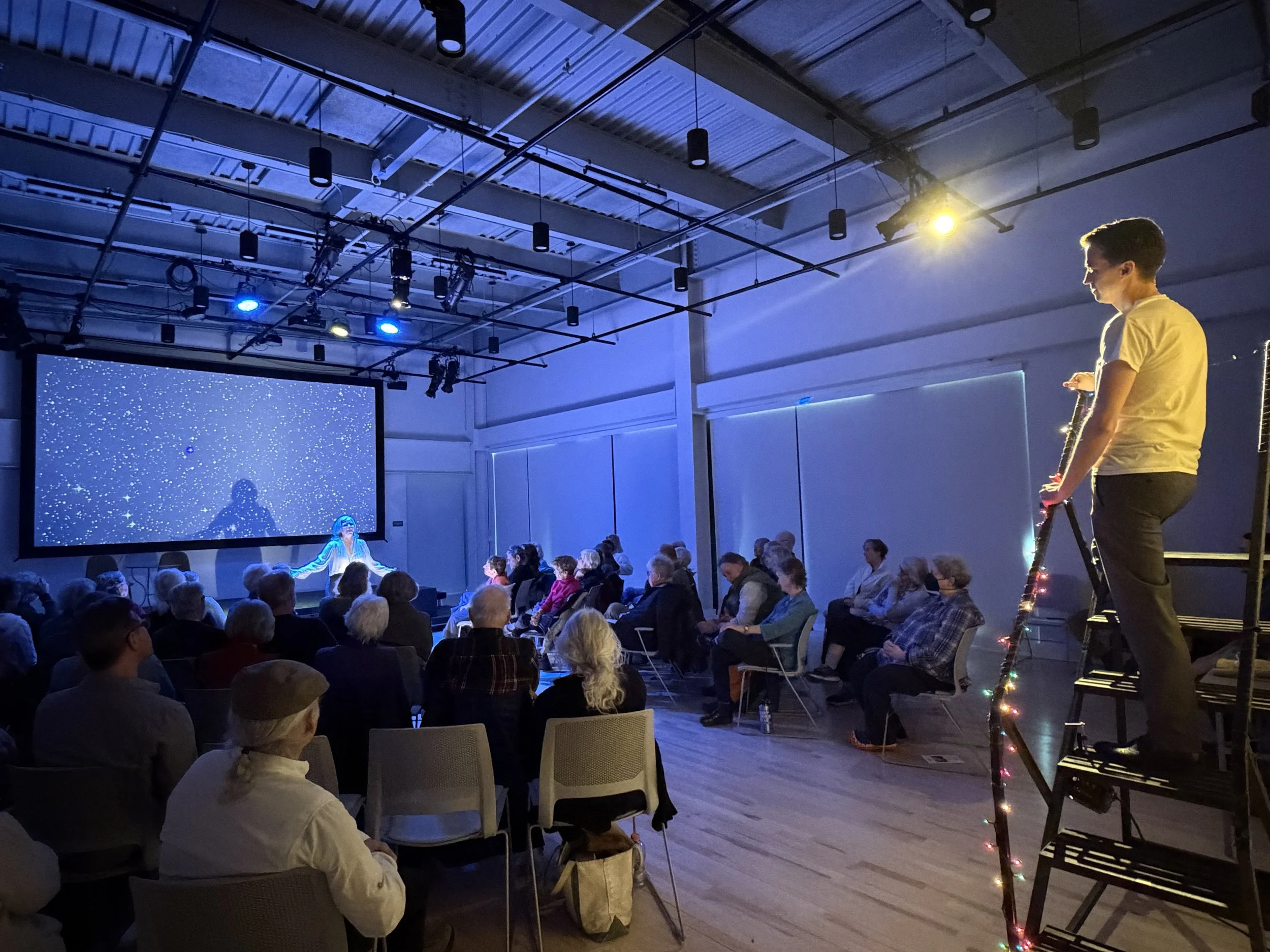
Stephen Haskett (James) and Laura Standley (Véronique Christory) perform in the final scene of Treaty in Town Hall Theater's Anderson Studio. Photo: Kate Middleton
What are some concrete steps people can take today?
There are many ways to join the effort. Here are a few ideas:
Join the ICAN Cities Appeal. You could ask your town's leadership to pass a resolution supporting nuclear disarmament and the TPNW. Over a thousand cities worldwide have joined, from Paris to Hiroshima to Los Angeles. In Vermont, only South Burlington and Winooski have so far. What about Middlebury, or others? Learn more at cities.icanw.org.
Contact your representatives. No Vermont member of Congress has signed the ICAN
Pledge, an initiative where legislators can express their support for the TPNW. You could reach out to Bernie Sanders, Peter Welch, or Becca Balint. Details at pledge.icanw.org.Divest from nuclear weapons. The nuclear weapons industry is largely the work of only 24 companies. If you manage your own investments, you can work to remove them from your portfolio. If you're connected to an institutional investor, like a church, endowment, or pension fund, you can encourage them to adopt a policy excluding these companies. Learn more at divest.icanw.org.
Join ICAN. Visit icanw.org/take_action_nowand follow @nuclearban on social media.
Reach out directly. If you'd like to share thoughts on the show or advance local advocacy, contact Seth at seth@icanw.org.
Treaty is Town Hall Theater's first collaboration with NYC-based Off-Broadway company Ground UP Productions. We're grateful to Seth, Kate Middleton, and the entire Ground UP team for bringing this work to Middlebury, and to our audiences for showing up ready to engage. Thanks for supporting new work!